


International mobility rarely becomes risky because HR makes the wrong decision.
More often, risk builds because no clear decision was ever made.
What begins as occasional business travel evolves into recurring presence.
A short-term arrangement gets extended “temporarily.”
Remote work across borders becomes normal practice.
At some point, tax, social security, or immigration obligations are triggered — often without anyone clearly noticing when the shift happened.
By the time the issue surfaces, HR is forced into a reactive position.
A Common Scenario
Across Europe and the EEA, the pattern is familiar:
- Business travel becomes frequent and recurring
- Assignments are extended several times
- Work is effectively performed in the host country
- Compliance exposure is discovered months later
The result is rarely dramatic at first. Instead, it creates:
- Undocumented risk
- Confusion for the employee
- Limited room for corrective action
This is not a policy failure.
It is a lack of operational visibility and structured decision checkpoints.
Insight: The EU/EEA 25% Rule – When Remote Work Quietly Triggers Compliance
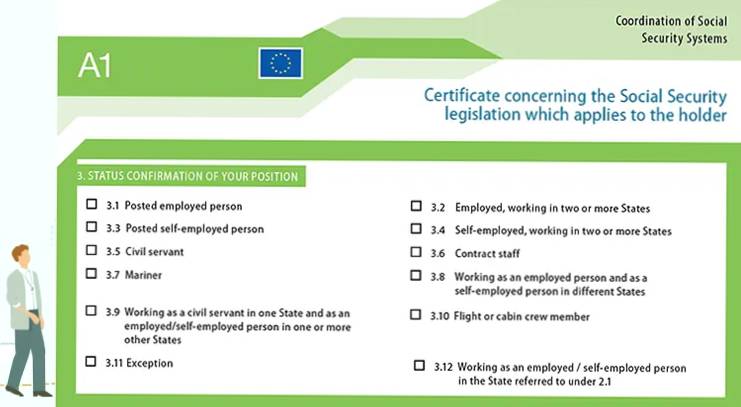
Within the EU/EEA framework, social security coordination rules create one of the most underestimated risks.
Under the 25% rule, if an employee performs 25% or more of their work in their country of residence, social security affiliation may shift to that country — regardless of where the employer is based.
Why This Creates Risk
- Remote workdays are rarely tracked precisely
- Business travel and home-office work are often assessed separately
- HR becomes aware only when payroll or auditors raise questions
Practical Consequences
- Social security affiliation changes unintentionally
- A1 certificates become invalid
- Retroactive corrections may be required
This is one of the most common examples of compliance exposure created not by intention — but by lack of visibility.
For Employees, Uncertainty Is Worse Than Tax
From the employee’s perspective, the biggest challenge is often not the tax level itself.
It is not knowing what applies.
Typical questions include:
- “Where am I actually tax resident?”
- “Am I still covered by social security?”
- “Why do different stakeholders give different answers?”
When answers are unclear:
- Trust in the process erodes
- Employees make assumptions on their own
- Errors occur despite good intentions
Transparency and predictability are therefore not just compliance issues — they are employee experience issues.
What This Means for HR and Leadership
Cross-border work must be managed as a continuous process, not as a series of exceptions.
That means:
- Identifying risk thresholds before they are exceeded
- Creating structured review checkpoints
- Documenting decisions while there is still room to act
Organizations that combine real-time visibility with practical mobility support are significantly better positioned to manage cross-border work — without slowing down the business.
How Practical Tracking Reduces Mobility Risk
The risks described above share one common root cause: lack of continuous visibility.
Tax, social security, and immigration exposure rarely arise overnight. They build gradually — and quietly.
This is where structured tracking, thresholds, and timely notifications become critical.
1. Presence and Activity Tracking
Without reliable tracking, HR often relies on fragmented travel data or self-reporting.
SWAIRI supports:
- Consolidated tracking of cross-border presence (travel, remote work, assignments)
- A centralized view across HR, payroll, and mobility stakeholders
- Clear differentiation between business travel, remote work, and assignment activity
Risk avoided:
Unintended permanent establishment exposure, unmonitored tax presence, and late discovery of social security triggers.
2. Threshold-Based Alerts (Including the EU/EEA 25% Rule)
Compliance risk is typically triggered by thresholds — not by single events.
SWAIRI enables:
- Automated monitoring of time spent per country
- Alerts when predefined thresholds are approaching
- Early warnings before A1 certificates or social security affiliation are impacted
Risk avoided:
Retroactive social security corrections, invalid A1 certificates, and unexpected cost increases.
3. Decision Checkpoints Before Risk Materializes
In many organizations, mobility decisions are made too late — after exposure already exists.
SWAIRI introduces:
- Structured decision points during the mobility lifecycle
- Notifications prompting HR review when patterns change
- Documented decisions supporting audit and compliance reviews
Risk avoided:
Undocumented exceptions, inconsistent handling across departments, and limited ability to demonstrate due diligence.
4. Employee-Facing Transparency
Employee uncertainty is often the first signal that something is misaligned.
SWAIRI provides:
- Clear visibility for employees on their mobility status
- Notifications when changes may affect tax or social security position
- Reduced dependency on informal guidance
Risk avoided:
Loss of employee trust, incorrect self-reporting, and reputational exposure.
Suggested Steps for HR to Avoid the Most Common Pitfalls
- Establish tracking as standard practice
Treat all cross-border work — travel, remote work, and assignments — as trackable mobility. - Define clear internal thresholds
Align internal triggers with regulatory thresholds such as the EU/EEA 25% rule. - Act on alerts early
Use notifications as decision prompts, not just information messages. - Document decisions centrally
Ensure mobility decisions are traceable and defensible. - Align employee communication
Provide consistent, transparent information throughout the mobility lifecycle.
Why This Matters Now
Cross-border work has become normal.
Compliance frameworks have not become simpler.
Organizations that combine technology-driven tracking with practical mobility advisory are better positioned to protect both:
- The business
- The employee experience
Many are now reassessing how international mobility is governed — moving from fragmented handling to structured oversight that supports compliance, predictability, and confidence.
The question is no longer whether mobility creates risk.
The real question is whether that risk is visible early enough to act on it.